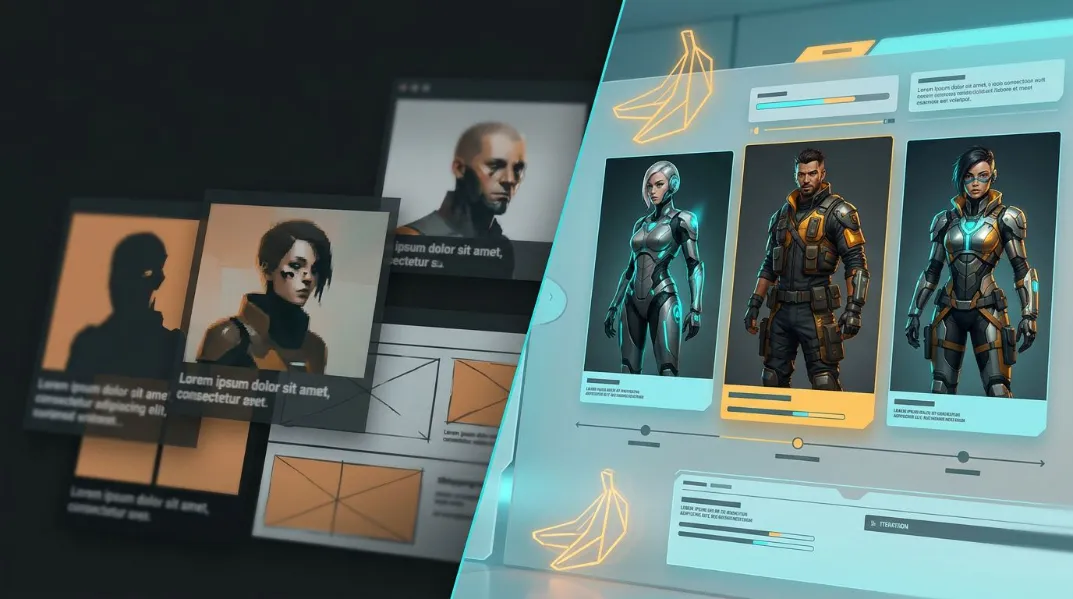
For the past few days, nano banana 2 has been everywhere. Most posts repeat the same line: faster, smarter, cheaper.
That sounds great, but speed alone is not why creators switch tools. What matters is this: can it produce usable work under real pressure?
After reviewing public launch details and practical tests discussed by early users, the answer is nuanced: Nano Banana 2 is not magic, but it is one of the first releases in this line that feels consistently useful for rapid production loops.
 The biggest shift is not one perfect output, but faster iteration with fewer dead ends.
Why This Release Feels Different
Older image models usually forced a tradeoff: you either got quality or speed. Nano Banana 2 narrows that gap enough to change team behavior.
Instead of “generate once, pray, and retry,” the loop becomes:
- generate quickly
- compare variants
- keep the strongest structure
- refine with clear intent
That sounds small, but if you ship visual content weekly, it changes your timeline.
For character-first creators, this is where the workflow becomes practical: use Nano Banana 2 for fast exploration, then move strong directions into structured OC pipelines like OC Maker, Genshin OC Maker, and Pokemon OC Maker.
What Nano Banana 2 Actually Improves
1) Text-in-image tasks are more practical
It is still not a typography tool, but headline-level text and short labels are more reliable than many users expected.
2) Multi-image storytelling is more stable
When one concept needs multiple frames, consistency tends to hold better in short sequences.
3) Structured visuals are easier to draft
Infographic-like layouts and UI-style compositions are less chaotic when prompts are specific.
4) Iteration speed changes production economics
Even when an output is not final-ready, teams can reach a useful draft faster and spend editing time where it matters.
 The quality jump usually comes from prompt control plus variant selection, not from a single lucky generation.
Where It Still Breaks
To keep expectations realistic, there are still clear failure patterns:
- mixed-style prompts can collapse visually
- long or dense text blocks still need manual cleanup
- complex object interactions can drift between variants
- “one prompt does everything” still fails often
So yes, it is stronger, but no, you should not skip human QA.
Three Practical Case Patterns
Below are patterns that are useful in production settings.
Case Pattern A: Poster with localized text
- Goal: ad-style visual with short copy overlays
- Often works: short text, explicit placement constraints
- Often fails: long copy over detailed backgrounds
Case Pattern B: Character consistency across three scenes
- Goal: same character identity across different environments
- Often works: fixed identity anchors (face shape, hair, signature outfit element)
- Often fails: changing style, camera, and mood all at once
Case Pattern C: Vertical infographic draft
- Goal: turn one concept into a readable 3-step visual
- Often works: clear hierarchy and section labels
- Often fails: tiny dense text and vague layout constraints
 NB2 case: vertical infographic draft with a strict three-block hierarchy.
If your priority is character continuity over one-off images, treat Nano Banana 2 as the fast draft engine, then lock reusable traits in an OC workflow through OC Maker, Genshin OC Maker, and Pokemon OC Maker.
 Consistency improves when identity anchors stay fixed and only scene variables change.
What This Means for OC Creator Workflows
If you build original characters, Nano Banana 2 works best as a speed layer, not a full replacement for your structured process.
A practical setup is:
- Explore visual directions quickly in Nano Banana 2
- Select one stable identity direction
- Rebuild with tighter trait control in an OC-focused flow
- Keep a reusable prompt skeleton for future variants
This keeps quality stable while preserving speed.
If you want the full production loop (prompt order, style lock, references, and iteration), follow How to Create Your Own Original Character with OC Maker (2026 Step-by-Step Guide).
Final Verdict
Nano Banana 2 is not valuable because it is trending. It is valuable when your workflow needs faster iteration, stronger prompt adherence, and better draft quality under time pressure.
Use it like a fast visual collaborator, not an autopilot designer.
Want to test this immediately? Start with one consistency challenge in Pokemon OC Maker, or build a cross-scene character concept from OC Maker.
Need a beginner-friendly baseline first? Read How to Create Your Own Original Character with OC Maker (2026 Step-by-Step Guide).